Technology & innovation
AI: Beyond Experimentation and Into Long-Term Strategy
We know that AI is set to redefine our lives on a scale far greater than the internet ever did. During a recent event I participated, I had an engaging conversation with few other participants about how enterprises should approach AI strategy. You might be wondering, “Is that even a consideration?” Not quite. One of my interlocutors argued that “AI strategy is short-lived, so the planning horizon for enterprises should be short too.” But he wasn’t alone, several colleagues echoed this sentiment, defending the position with a mix of reasoning and skepticism. Their perspective was compelling enough to bring to this space, where I hope to hear from others as well. They backed their claims with points that are worth exploring:
- Rapid Technological Evolution: AI evolves so fast that strategies tied to specific tools or frameworks quickly become obsolete.
- Shifting Competitive Landscapes: Competitors are adopting AI at different speeds, creating a race to keep up.
- Regulatory and Ethical Challenges: Unresolved issues around data privacy, intellectual property rights, and algorithmic bias pose risks that can derail even the most well-intentioned plans.
- Limited Justification for Large Investments: Studies suggest that the financial payoff for AI investments remains uncertain, making it hard to commit to significant spending.
This viewpoint resonates with many who are hesitant to fully commit to a long-term vision for AI. The pace of technological evolution, shifting market dynamics, and regulatory uncertainties indeed make long-term planning seem daunting.
But here’s the thing: while these challenges are real, I believe they underscore the need for bold, long-term strategies rather than short-term thinking. Balancing short-term value with long term gains is important, but a narrow focus on immediate wins misses the bigger picture. Short-term thinking about AI strategy can lead to missed opportunities and, ultimately, a loss of competitive edge. Here’s why, in my view, a bold, long-term AI strategy is the smarter choice.
Experimentation is Not Strategy
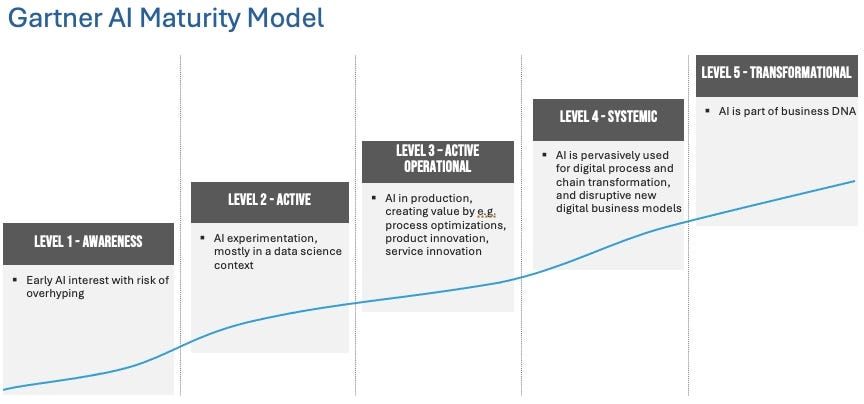
Think of it this way: experimentation is an essential starting point for exploring AI’s potential, but it’s not a substitute for a cohesive, forward-looking strategy. Simply put, testing AI use cases without a broader plan leaves organizations stuck in a cycle of limited, incremental gains.
- It’s important to note that the competitive landscape is also being fundamentally redefined. Marco Iansiti and Karim R. Lakhani describe this phenomenon as “collisions”, instances where traditional organizations face off against digital-first competitors, such as Uber versus traditional taxi companies. These digital organizations operate under different rules, leveraging what they call “AI Factories” to industrialize data processing, decision-making, and innovation. By removing traditional constraints on scalability, scope, and learning, digital-first firms create significant advantages that traditional organizations struggle to match.
- The reality is, many organizations remain in the experimentation phase. According to the LXT survey, “The Path to AI Maturity,” which is based on the Gartner AI Maturity Model, 28% of mid-to-large U.S. organizations are still in the early stages of AI adoption, classified as “Experimenters.” Within this group, 14% are in the “Awareness” stage, where interest in AI is high, but practical applications remain limited. Another 14% are engaged in “Active experimentation,” running isolated pilot projects without broader integration into their operations. These organizations risk falling into a cycle of fragmented initiatives that fail to scale or deliver sustained value, leaving them unprepared to compete effectively in an increasingly AI-driven economy.
- Here a couple of examples of a long-term view: ServiceNow used AI to cut customer service resolution times by 80%. This success wasn’t achieved through isolated experimentation but through thoughtful integration of AI into their operational framework. Similarly, companies like Amazon have turned AI experimentation into strategy by using insights from early tests (e.g. optimizing warehouse operations) to deploy machine learning across their logistics, e-commerce, and AWS ecosystems. These examples highlight how deliberate strategy and an integrated approach, not ad hoc projects, deliver transformative outcomes.
- What this means is experimentation should inform and shape a long-term vision for AI integration, but experimentation alone cannot prepare organizations for these competitive collisions. Enterprises must focus on building cohesive AI strategies that enable scalability, adaptability, and continuous learning to compete effectively with digital-first disruptors.
- The key takeaway is organizations must move beyond isolated AI trials to develop strategies that connect use cases to long-term business objectives. Experimentation without strategy is like planting seeds without planning a garden, you might see some growth, but it won’t be sustainable or cohesive.
AI Investment Cycles Mirror Past Transformations
History has shown that major technological revolutions often begin with uncertainty and skepticism. The early days of the internet, cloud computing, and smartphones were characterized by high upfront costs, slow adoption, and unclear short-term returns. AI is following a similar trajectory, and the lessons from these earlier transformations offer a valuable blueprint for enterprises today.
- Here’s the thing: Just as the internet reshaped global commerce and communication, AI is poised to redefine industries on an even larger scale. A Goldman Sachs report projects that generative AI alone could contribute up to 6.1% of global GDP growth over the next decade, highlighting its transformative potential despite early-stage uncertainties.
- What this means is current AI investments should be seen as part of a foundational phase, similar to laying the tracks for a high-speed train. While the upfront costs may appear steep, the long-term rewards in operational efficiency, customer satisfaction, and innovative capacity and adaptation are substantial. Companies making these investments now will reap the benefits further down the line. McKinsey reports that early adopters of AI already report higher profitability compared to their peers, primarily due to their ability to scale AI solutions across diverse functions like marketing, operations, and R&D.
- Here’s an example: Nvidia has experienced exponential growth thanks to the boom in AI workloads. But they started well ahead of this time. This foresight and strategic focus have made Nvidia indispensable in powering applications ranging from generative AI to advanced robotics. Similarly, Amazon Web Services (AWS) has embedded AI capabilities into its cloud offerings, creating a feedback loop that drives both customer adoption and continuous innovation, ensuring its leadership in multiple markets.
- It’s also worth noting that AI investments aren’t just limited to digital-native firms. Traditional organizations across sectors are leveraging AI to modernize their operations, underscoring its universal appeal. For instance, the IBM Global AI Adoption Index 2023 found that 82% of large enterprises have deployed or are actively exploring AI solutions, demonstrating widespread recognition of its transformative potential.
- The key takeaway is businesses adopting a long-term perspective on AI investments are positioning themselves to capture the exponential value these technologies will unlock. The leaders of today aren’t just experimenting with AI, they’re strategically building the infrastructure and capabilities that will define success in a future AI-driven economy.
The Boldest Strategy is Often the Safest
One thing to keep in mind is that playing it safe can actually be the riskiest approach. Waiting for perfect conditions or guaranteed returns often leads to missed opportunities and falling behind. The boldest strategies, on the other hand, are those that position organizations for long-term leadership by building a strong foundation.
- Let me highlight the key point: A bold strategy doesn’t mean making reckless bets. It involves deliberate investments in creating the foundational “AI Factory.” This fabric integrates AI seamlessly across the enterprise, including robust data infrastructure, scalable cloud platforms, and comprehensive governance frameworks that ensure security, compliance, and ethical use.
- Incorporating the AI Factory also means adopting modular, flexible systems that can evolve with rapid technological advancements. By leveraging adaptable infrastructure, organizations can quickly integrate new AI innovations without losing sight of long-term objectives. Cross-functional teams that collaborate effectively across business units are critical to maintaining this adaptability while driving value creation.
- What this means is organizations that prioritize building the AI Factory are not just implementing isolated AI solutions but creating an infrastructure capable of scaling innovation. This approach minimizes redundancy, accelerates deployment, and ensures that all AI initiatives align with long-term strategic goals. It also allows enterprises to deliberately address the growing technical challenges of AI workloads, such as high energy demands, the need for ever-powerful accelerated computing platforms, the sourcing and quality of data, etc.
- The key takeaway is bold strategies rooted in foundational AI infrastructure create resilience and adaptability. By investing in systems designed to evolve, organizations can remain agile while leading in an AI-driven economy. Instead of reacting to external pressures, organizations with a well-integrated AI Factory are equipped to drive sustainable growth.
Governance and Sustainability Require a Long View
AI’s impact isn’t limited to business operations, it intersects deeply with governance, ethics, and sustainability. Addressing these issues requires forward thinking strategies, especially as global regulatory frameworks continue to take shape.
- It’s worth mentioning that upcoming legislation, such as the EU AI Act, will impose comprehensive obligations on AI systems based on their risk levels, setting a global benchmark for governance. These rules will require transparency, robust risk assessments, and accountability mechanisms, influencing how businesses design, deploy, and monitor AI.
- In the U.S., while no comprehensive federal law exists yet, initiatives like the National AI Initiative Act and the White House’s Executive Order on AI are beginning to shape the regulatory landscape. These frameworks emphasize safe, secure, and trustworthy AI development, focusing on issues such as content authentication, safety testing, and algorithmic fairness.
- Sustainability concerns are tied directly to AI’s growing energy demands. Training and running advanced AI systems, such as large language models, require immense computational power. For instance, research by Epoch AI shows that training runs for models like Llama 3.1 405B utilized a cluster of 16,000 GPUs, consuming 27 MW of total power, which is the equivalent to the average yearly consumption of 23,000 U.S. households. The same report says that frontier AI training runs by 2030 are projected to be 5,000 times larger in scale, potentially requiring up to 6 GW of power, 200 times the demand of Llama 3.1 405B.
- Scaling infrastructure to meet these demands poses significant challenges. The development of massive data center campuses, capable of supporting training runs up to 2e29 FLOP, will require innovative approaches to power generation and distribution. Options such as on-site power generation, local grid supply, and geographically distributed training networks are being explored to address this need. You’ve probably heard on the news that companies like Google, Amazon, and Microsoft have announced their intentions to invest in nuclear energy to address these challenges. While energy efficiency improvements, like FP8 precision formats and extended training durations, are expected to make hardware and processes 24 times more efficient by 2030, the sheer scale of AI training will still drive substantial power consumption.
- What this means is enterprises must proactively embed sustainability into their AI strategies. Investing in renewable energy sources, optimizing algorithms for energy efficiency, and adopting distributed training networks can help offset environmental impacts. For instance, large-scale adoption of renewable energy for data centers, paired with power-efficient GPUs, can ensure that AI innovation aligns with sustainability goals. By taking these measures, organizations can reduce their carbon footprint while preparing for stricter regulatory oversight and growing societal expectations for sustainable practices.
So, What’s the Bottom Line?
AI may feel like a moving target, but that’s no reason to shy away from long-term strategy. In my view, short-term thinking risks leaving opportunities on the table, while bold, forward-looking strategies create a foundation for sustainable and scalable success.
Now, consider this: experimentation has its place, it’s important for discovering AI’s potential. But without a bigger vision, it won’t take you far. I recommend balancing quick wins with strategic investments that focus on building the AI Factory. This integrated ecosystem of data, infrastructure, and governance doesn’t just enable immediate results, it positions your organization to scale, adapt, and innovate as technology evolves.
What’s your take? Are you or your customers prioritizing a short-term wins or planning for the long haul?
Note: This story was first published on LinkedIn