Technology & innovation
How Platforms Earn Premium Valuation Multiples — A Practical Framework for Founders, Operators, and Investors.
I’ve sat through dozens of product reviews this year. One recurring theme: “platform” is used as shorthand for ambition, while the valuation mechanics get blurred. Here’s a practical way to define a platform, and why the distinction changes what you build and how you’re valued. To make it concrete, here’s a composite snapshot I keep seeing in pitch rooms and a simple “gravity test” you can run on your own product.
A common pattern
In some rooms, teams embrace the platform label because there’s an SDK slide and marketplace aspirations. The product is polished, the demo crisp, but the model still looks like a two party contract between a buyer and a vendor. In other rooms, founders avoid the label yet already show ecosystem signals: partners building extensions, steady API traffic, customers who say switching would be painful. Same word, “platform”, used two ways. Only one shows gravity.
Moments like these remind me that platforms aren’t declared, they’re revealed by behavior. You see it in who shows up, how tightly the product sits inside a customer’s workflow, and whether third parties can make money on top. When those three threads braid together, the business starts to compound and investors notice.
The gravity test
Imagine your product six months after launch. You’ve landed fifty customers. In the product company version of the story, usage is steady, a handful of features ship, and churn is driven by budget cycles. In the platform version, something else happens: customers invite partners into the workspace, developers hit your APIs more each month, a niche vendor ships an add‑on that solves a problem you never planned to tackle. Growth begins to come from outside your walls. That’s gravity.
Why gravity changes valuation
Public markets translate that gravity into a premium because it tends to show up as durable growth and better unit economics. A simple example: if a cohort started the year at $1.0m and ends at $1.25m purely from upsell and usage, your Net Revenue Retention is 125%. You haven’t added new customers, yet revenue expanded. Pair that with a mix shift toward high‑margin revenue, usage, marketplace take‑rates, partner add‑ons and the story earns a higher EV/Revenue multiple without hand‑waving.
When investors say “multiple,” they’re not invoking alchemy. They’re compressing a view about tomorrow into a number today: will growth persist? will margins improve as you scale? and are you hard to rip out? Platforms tilt those answers toward yes.
Why this matters if you’re building
If you’re building, this distinction saves you from chasing vanity milestones. It nudges you to ship stable interfaces before splashy features, to treat partners and developers as first class users and to anchor pricing to the value created as usage deepens. It sharpens sequencing, tighten a single workflow loop, then expose the APIs that make it repeatable, then invite others to extend it. In that way gravity can form on purpose rather than by accident. And it gives you a sober investor narrative. What I mean by that is: not “we have a marketplace tab” but “our cohorts expand, third parties earn money here, and the product is hard to rip out”. That’s the difference between a product that grows and a platform that compounds.
From narrative to proof
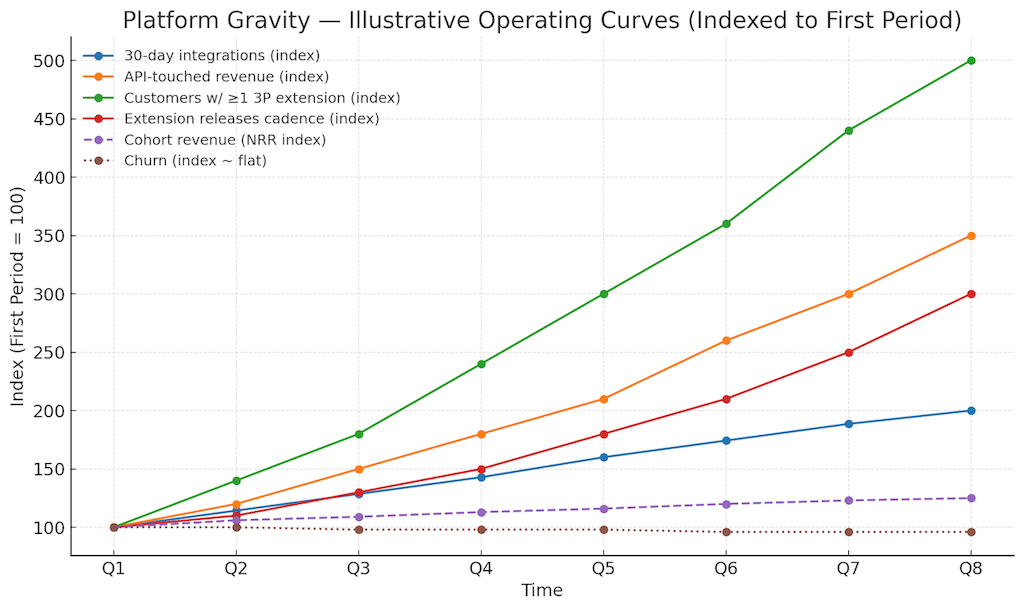
If you want the market to believe the word platform, show the evidence inside everyday operations. Track how many customers connect to outside tools in their first thirty days. Watch API‑touched revenue as a share of total revenue. Measure how many customers rely on at least one third‑party extension to run their business and how often those extensions ship new releases. Then plot those curves next to your cohorts. When the lines slope up and the churn line stays flat, your story tells itself.
Designing your re‑rating
You don’t need to wait for gravity to appear, you can design for it. Open more of the product as an API surface so workflows live inside you, not beside you. Seed a small, curated marketplace and help the first partners earn real money so there’s proof of third‑party value creation. Price so value scales with use while keeping guardrails for predictability. Publish reference architectures so the first integration takes hours, not weeks. Link each move to the operating curves above, then measure the shift.
The bottom line
Ship the work that bends the curves. That means more integrations per account, a higher share of API touchedrevenue, growing third-party earnings, stronger NRR. Do that consistently and the multiple takes care of itself.