Technology & innovation
Hype as a Coordination Tool and the Trap of “Irreversible Standards” in AI
Early last week, I read an excellent article by Sangeet Paul Choudary that discussed the strategic role hype plays in coordinating fragmented markets such as AI. The article drew an interesting parallel with Renaissance-era Florence, a city lacking the typical medieval moats of its neighbors but instead protected by a powerful narrative. Florence became culturally and symbolically so significant that attacking it imposed enormous social and reputational costs.
Translating this lesson to the AI landscape, the article proposes that hype is more than flashy marketing, it is a strategic tool for coordination. In an emerging field marked by many interdependent players (from researchers and regulators to investors and end-users), hype can align diverse stakeholders around a common vision. Much like Florence, a tech company or AI project that harnesses a powerful narrative can attract the capital, talent, and partnerships needed to move from idea to reality. However, the article also warns that hype can be misused, creating inflated expectations that collapse under scrutiny. When wielded responsibly, though, hype helps overcome the inertia and fragmentation that often stymie progress in rapidly evolving sectors. In fact, it offers a compelling alternative to the traditional “economic moats” approach.
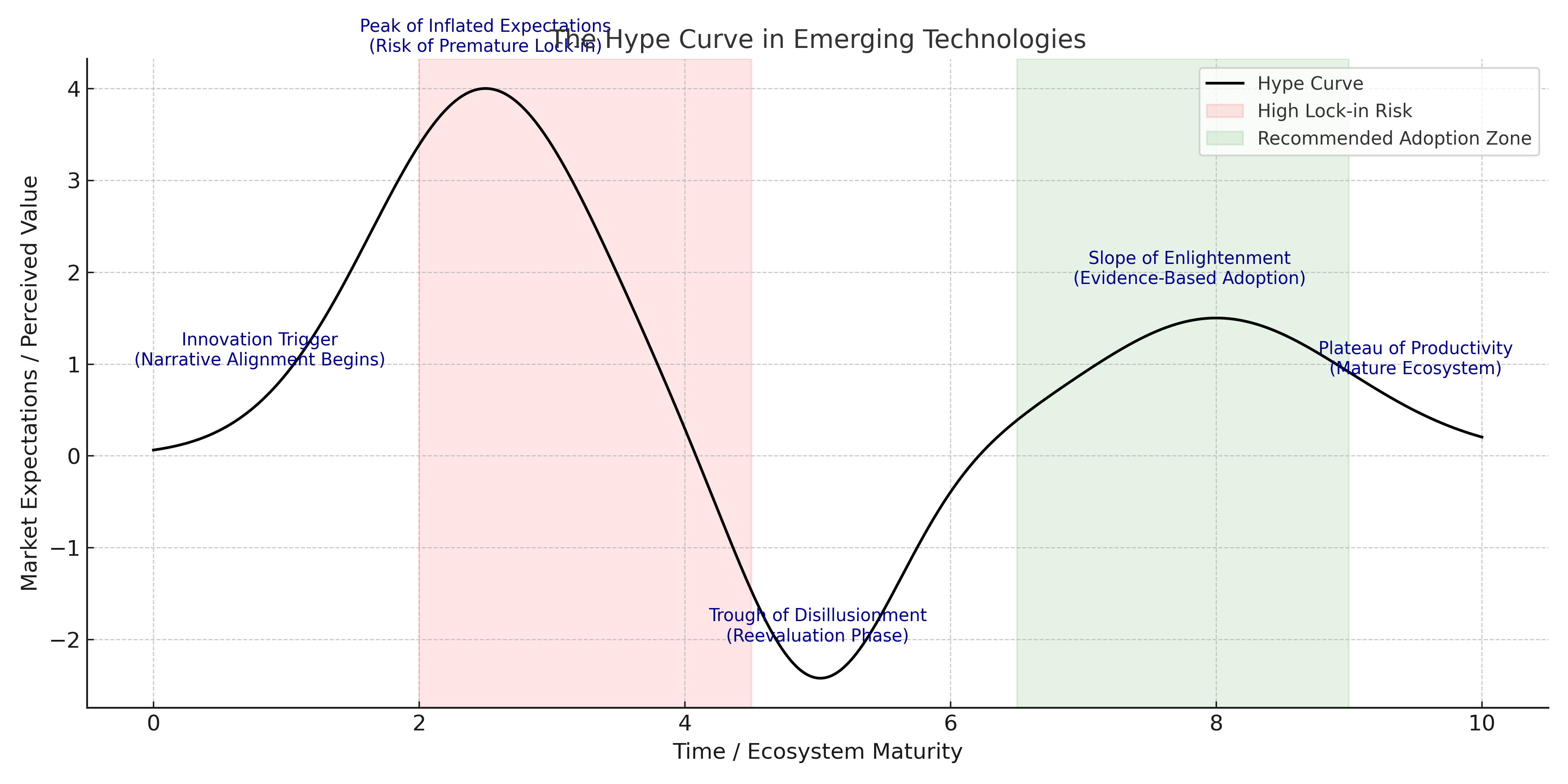
And yet, there’s another, equally significant impact of hype: while hype can rally a fragmented market, it also risks entrenching early, sometimes flawed, solutions as “industry standards”. Much like Renaissance Florence, a tech player armed with a compelling narrative can effectively dissuade challengers. But if that narrative outstrips technological maturity or stifles competition, the entire ecosystem could lock into suboptimal practices. In the sections ahead, we’ll explore how hype can set lasting economic standards in AI. Ultimately, wielding it responsibly can be the difference between unlocking transformative innovation or falling into an expensive strategic trap.
Hype as a Coordination Mechanism in Fragmented Markets
Fragmented markets typically struggle to scale because there is no single focal point guiding investments, talent, and shared standards. Within AI, hardware vendors, model developers, research labs, and regulatory bodies often operate under divergent agendas. Such a splintered ecosystem often leads to numerous standards and proof-of-concepts that rarely gain broader traction.
Without alignment on business practices or technical protocols, major players struggle to effectively pool resources. A strategic narrative breaks this stalemate by framing a compelling, forward-looking vision, akin to Florence’s Renaissance ideal. For example, large language models (LLMs) became a rallying point once ChatGPT gained global prominence, catalyzing investment, talent influx, and rapid ecosystem expansion. Capital poured in due to fear of missing out (FOMO), skilled practitioners gravitated toward the models behind the tool, and complementary services flourished, much like how Florence attracted artists and philosophers.
From Hype to Irreversible Economic Standards
When hype aligns an ecosystem, it can quickly transform widely adopted frameworks, protocols, or business practices into economic standards. But rapid adoption sometimes comes at the cost of a solution becoming default due to market momentum rather than technical superiority or efficiency. Examples include:
- AI frameworks or platforms. Many organizations treat OpenAI’s GPT-based models as a de facto reference. Competing approaches might be more efficient, but they struggle to overcome GPT’s head start in mindshare, developer tooling, and partner integrations.
- Infrastructure standards. Tesla’s early supercharger network setting de facto EV charging standards.
- Investment or valuation benchmarks. Valuations inflated by AI narratives becoming baselines for future investments (whether justified or not). For instance, the latest Open AI valuation is set at $300 billion, Anthropic is valued at $61.5 billion.
Hype rapidly creates market alignment, establishing early-mover advantages through path dependence (where past decisions significantly constrain future choices). It attracts substantial early resources (capital, talent, partnerships), cementing credibility and urgency (FOMO among investors and competitors), solidifying certain technologies or strategies as “must-haves.”
Lock-in often occurs through network effects, meaning products become more valuable as adoption increases. Complementary tools are built specifically around early frameworks, entire workforces develop expertise in these standards, and sunk costs accumulate, making future transitions costly. Even after initial enthusiasm fades or hype is proven exaggerated, the infrastructure, systems, or investments created remain deeply embedded despite superior alternatives emerging later. A few examples come to mind:
- The QWERTY keyboard layout, initially designed to slow typists to prevent mechanical jams, still remains a global standard despite more efficient layouts being available.
- Similarly, in AI, certain deep-learning approaches or large foundational models might remain standard, despite potential inefficiencies or limitations, simply because ecosystems, tooling, and markets have coalesced around them.
The Strategic Trap: Hype’s Double-Edged Sword
In his article, Sangeet rightly observes that once hype becomes mainstream, it turns into a strategic trap for late movers. However, we also need to consider another strategic trap that emerges when markets become locked into suboptimal standards or practices. And it happens because changing direction becomes economically or operationally too costly. Therefore, creating economic inefficiencies and loss of value. This may have several consequences:
1. Reduced Competition: New entrants must either conform to established standards or bear substantial costs to develop alternatives. For instance, consider the Zeus GPU from Bolt Graphics, they are achieving breakthroughs in gaming performance by skipping rasterization and moving straight to full-scene path tracing. That’s extremely expensive, both in terms of effort and resources.
2. The Coordination Trap: Hype-induced urgency may lead stakeholders to prioritize rapid adoption over long-term quality or sustainability. That might fix short term fragmentation but can embed flawed solutions (like proprietary data pipelines or half-baked model architectures) into everyday workflows.
3. Economic waste: Markets become over-invested in narratives rather than economic fundamentals. This leads to misallocation of resources into a few players rather than fostering diversity
4. Innovation bottlenecks: Smaller, potentially groundbreaking projects are overshadowed if the market (and its resources) pivot en masse to the hype-dominant model.
A cautionary tale is the over-investment in blockchain/crypto startups following the cryptocurrency hype in the mid-2010s. Despite considerable inefficiencies and rampant speculative volatility, the ecosystem’s collective momentum persists (even after the hype cooled), higfhlighting how difficult it can be to dismantle a standard once it’s widely accepted.
A Life Cycle View: After the Hype Subsides
AI hype doesn’t just create temporary excitement and alignment, it structurally reshapes markets, setting standards and strategies that become economically entrenched. Organizational tooling and knowledge deeply integrate with these standards, making change economically prohibitive. These strategic traps are easy to enter but extremely costly and complex to exit, significantly influencing long-term market trajectories and innovation ecosystems.
Industries typically either continually patch deep-rooted standards, creating long-term complexity, or undertake major, disruptive pivots. Such pivots, although sometimes necessary, are resource-intensive and require collective buy-in from regulators, major tech players, and industry consortia.
Safeguarding Against Premature Lock-In
From my perspective, one of the best ways we can avoid getting stuck with rigid or inefficient AI standards is by adopting a few strategic measures from the outset:
1. Adopt Open, Modular Systems. Why? Open-source frameworks can encourage healthy competition, facilitate interoperability and resilience, reducing risks associated with being locked into one model or platform.
2. Risk-Based, Adaptive Regulation: Regulators that evolve (….but that’s for another post) alongside technology are better at preventing one company’s hype from becoming the industry-wide default. Incentivizing open interfaces, clarifying liability, and requiring data portability can keep the field dynamic.
3. Encourage Critical Assessment: Finally, I believe in piloting new AI tools carefully before rolling them out. Organizations should run pragmatic experiments and lean on real-world data, emphasizing evidence-based decisions over reactive adoption of hyped technologies. Avoid letting hype alone set your roadmap.
Conclusion: A Balanced Way Forward
Reflecting on the story of Renaissance Florence, it’s clear that hype, utilized effectively, can coordinate fragmented markets and accelerate innovation — just as Florence’s narrative-driven diplomacy once kept it safe. However, the economic danger emerges when enthusiasm outpaces critical evaluation, potentially locking industries into costly and suboptimal standards.
I see a true middle is possible. Use hype to coordinate and overcome inertia. Yet temper this excitement with open standards (great job done by @IBM in this space), adaptive regulation, and measured implementation (leveraging data-driven validation indeed).
Yes, hype may be a “necessary evil” for moving forward. But by acknowledging both its potential and its pitfalls we stand a better chance to ensure that technological progress evolves in step with long-term economic viability.