Technology & innovation
NVIDIA’s CUDA: The Winning Strategy for AI and Computing Innovation
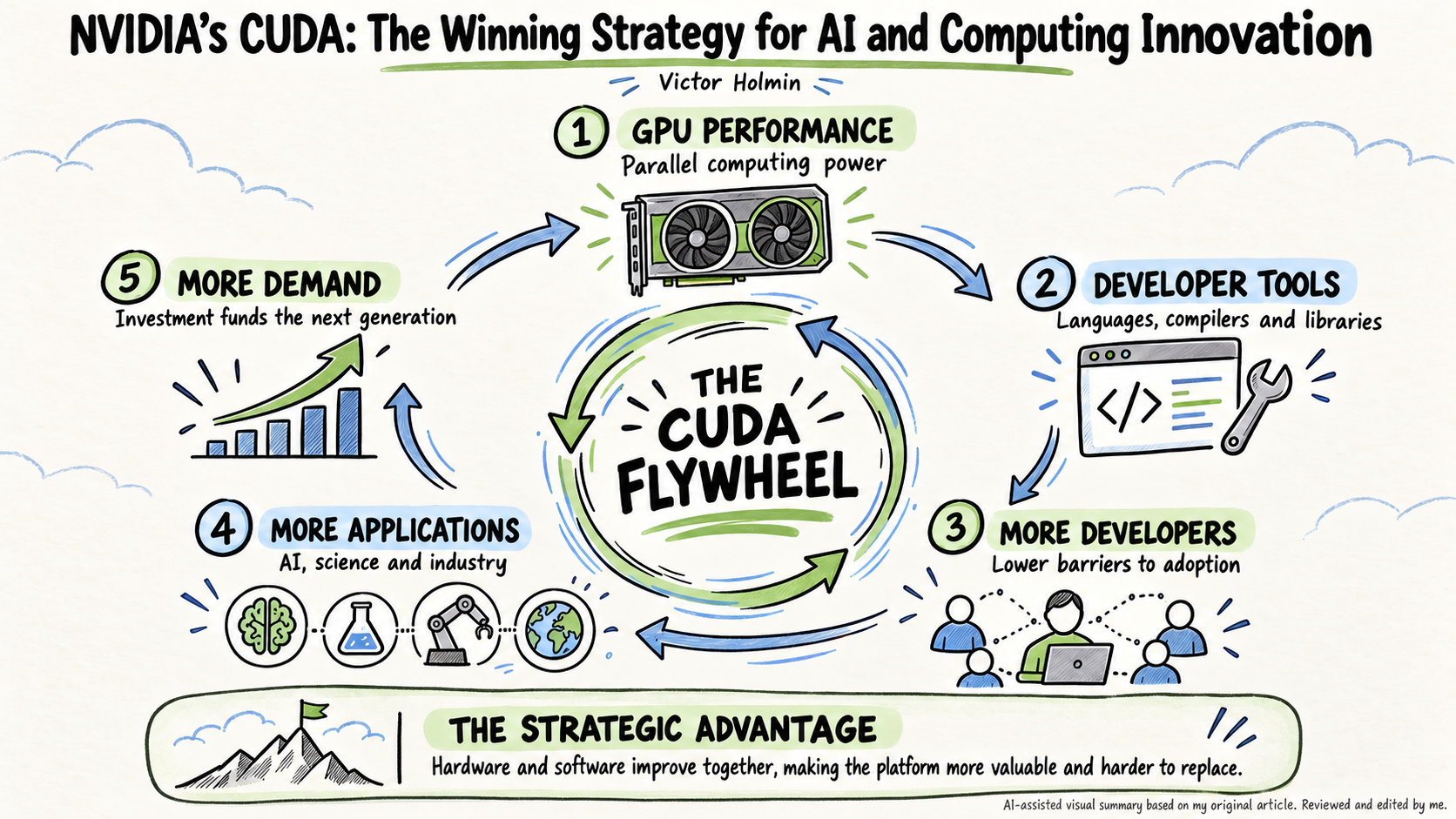
NVIDIA’s CUDA (Compute Unified Device Architecture) has become the backbone of a transformative revolution in computing. By seamlessly integrating CUDA with NVIDIA’s GPUs, the company has built a robust platform that delivers exceptional performance and versatility. This synergy not only solidified NVIDIA’s dominance in the GPU market but also positioned CUDA as the foundation for a wide range of advanced computational applications, from scientific research to artificial intelligence and machine learning. Moreover, NVIDIA’s strategic use of the keystone advantage, a concept where a central player drives the success of an entire ecosystem, has allowed it to lead and also shape the broader computing ecosystem.
The Power of a Closed Ecosystem
One of the key factors contributing to NVIDIA’s success is its strategic decision to maintain a closed hardware ecosystem. CUDA is designed to run exclusively on NVIDIA GPUs, allowing the company to maintain a strict control over hardware and software integration. This exclusivity ensures that CUDA is optimized for peak performance and reliability, providing developers with the tools they need to push the boundaries of what’s possible in computing.
By restricting CUDA to its own hardware, NVIDIA has been able to maintain high standards of quality and also drive hardware sales. Developers and organizations that want to harness the full power of CUDA must invest in NVIDIA GPUs, creating a strong demand for the company’s products. This strategy has helped NVIDIA stay ahead of competitors and maintain its leadership in the industry.
What underpins this strategy is NVIDIA’s understanding and application of the keystone advantage. As the keystone player, NVIDIA ensures that its closed ecosystem is not just about exclusivity but about creating unparalleled value for users and the platform itself. Here the ecosystem becomes a network of interdependent components, software, hardware, and support, that are all centered around CUDA, with NVIDIA at the helm directing the flow of innovation and maintaining the ecosystem’s overall health.
Achieving the Tipping Point of the CUDA Virtuous Cycle
Jensen Huang recently highlighted that CUDA has reached the tipping point of its virtuous cycle, a self-reinforcing loop that propels the platform to new heights. This cycle is driven by three core components: innovation, adoption, and growth. Each of these components is reinforces each other, while NVIDIA’s central position in the ecosystem allows it to influence and accelerate the growth of the entire network.
Innovation is one of the engines that drives the CUDA platform. NVIDIA’s continuous improvements to both CUDA and its GPU architectures attract a growing number of developers by providing them with increasingly powerful tools. These innovations are not developed in isolation but are deeply integrated into the ecosystem, ensuring that every advancement benefits all parts of the network.
Adoption, as more developers adopt CUDA, they create advanced applications that demonstrate the platform’s capabilities. These applications, ranging from cutting-edge AI models to sophisticated scientific simulations, showcase the power of CUDA and encourage further adoption. The widespread use of CUDA across different domains reinforces NVIDIA’s central position in the ecosystem, allowing it to set standards and best practices, which further drives adoption and creates a positive feedback loop where each new adopter adds value to the ecosystem, making it more attractive to subsequent users.
Growth, the combination of innovation and adoption leads to growth, not just for NVIDIA, but for the entire CUDA ecosystem. As more developers and industry partners join the ecosystem, they contribute to its expansion, creating a self-reinforcing loop of growth and innovation. NVIDIA’s keystone position allows it to harness this growth, ensuring that new entrants to the ecosystem align with the company’s strategic goals and contribute to the overall health of the network. This expanding ecosystem makes CUDA an increasingly attractive platform for new developers, who in turn drive further innovation and adoption.
Reaching Critical Mass
NVIDIA’s consistent support for developers and its continuous enhancement of CUDA’s capabilities have brought the platform to a critical mass. At this stage, the platform’s widespread adoption fuels exponential growth and continuous improvement. The more developers use CUDA, the more valuable it becomes to everyone in the ecosystem.
This critical mass is a significant milestone for NVIDIA, as it signals that CUDA is no longer just a powerful tool for a select group of developers. It has become an industry standard, a platform that delivers the most value to its users while continuing to evolve at an accelerating pace. By reaching critical mass, NVIDIA ensures that the network effects generated within the ecosystem become self-sustaining, reinforcing the company’s central position and making it increasingly difficult for competitors to disrupt.
The Future of CUDA and NVIDIA
As CUDA continues to grow, its virtuous cycle will only become stronger. NVIDIA’s commitment to innovation, its closed hardware ecosystem, and the ever-expanding community of developers ensure that CUDA remains at the forefront of computational technology for years to come, pushing the boundaries of what’s possible, driving the future of AI (in the wider sense of the word) and beyond.
In conclusion, the CUDA platform exemplifies the power of well-executed platform and ecosystem strategies. By leveraging the keystone advantage, NVIDIA has been able to position the platform as an indispensable tool for developers, securing its dominance in the rapidly evolving landscape of computational innovation and setting the stage for xcontinuous industry leadership.
If you are interested in learning about platforms and ecosystems strategies in innovation, I recommend the books: The Keystone Advantage by M. Iansiti and R. Levien and The Wide Lens by R. Adner.
Originally published on LinkedIn.