Technology & innovation
NVIDIA’s Strategy: From GPUs to AI Industry Dominance
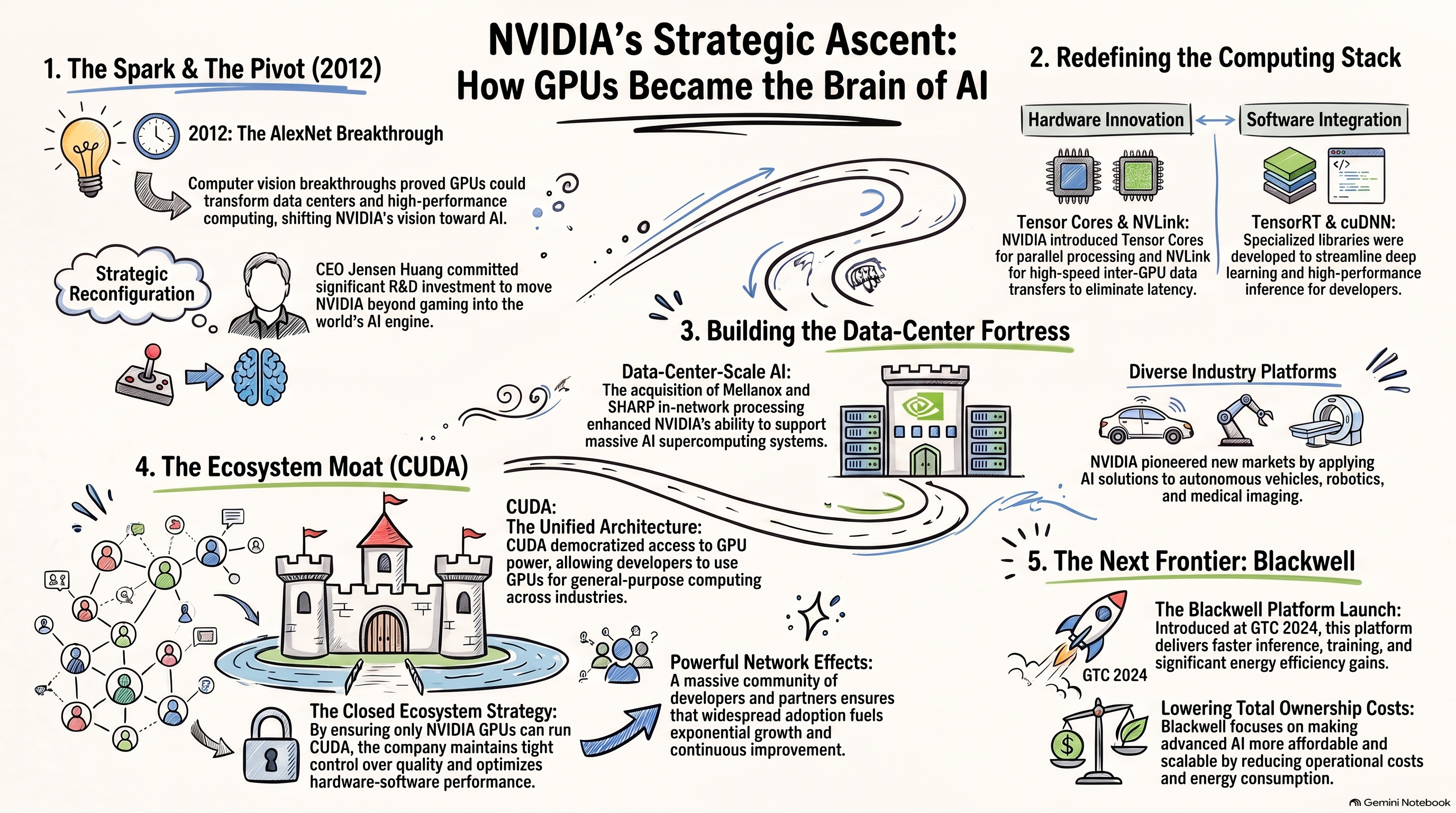
In the summer, I listened to the NVIDIA’s Annual Meeting of Stockholders recording. This prompted me to review NVIDIA’s current and past annual reports and press releases, varied independent press articles and my own notes to understand how NVIDIA got here. It was in the first place, the company realization of the GPU’s potential beyond graphics and gaming. It appears that it was the AlexNet on NVIDIA breakthrough in computer vision in 2012, the trigger to recognizing early on the GPUs ability to transform data centers and high performance computing. Jensen Huang strategically reconfigured NVIDIA’s to seize the opportunity. This vision was not only bold but also required significant investments in research and development to be realized.
From that moment on NVIDIA pursued a multi-pronged strategy
- Redefined the full computing stack: with each new generation of processors, NVIDIA has continually and significantly improved GPU performance, introducing innovations like Tensor Cores which enhanced parallel processing capabilities, crucial for AI workloads. Likewise, latency and throughput have greatly benefited from technologies such as NVLink for inter GPUs data transfer. NVIDIA has also committed substantial efforts to develop turn key solutions by integrating and optimizing different tools and components for specific use cases and workloads. Moreover, the constant perfecting of their software solutions with the aim of attracting developers cannot be overstated. For instance, libraries like TensorRT for high performance inference and cuDNN for deep learning help streamline the development process
- NVIDIA evolved to become a key data-center-scale AI player: particularly the acquisition of Mellanox and the development of SHARP in-network processing, significantly enhanced its capability to build and support large-scale AI supercomputing systems. Additionally, NVIDIA’s focus on scalability ensured efficient and effective operations as AI models grew in complexity.
- NVIDIA emerged as an AI leader and pioneered new markets by investing in AI research, leading to breakthroughs in neural graphics, autonomous vehicles, robotics, and medical imaging. Their application-specific platforms demonstrated the ability to apply AI solutions across diverse industries, creating new multi-billion-dollar markets.
- NVIDIA became a formidable ecosystem builder by supporting a growing community of CUDA developers with robust tools, libraries, and technical support, and by partnering with major tech companies and cloud providers to integrate CUDA and NVIDIA GPUs into various services and applications. By providing essential resources and fostering a collaborative environment, NVIDIA has driven innovation and growth. Through strategic partnerships and shared goals, NVIDIA has transformed isolated efforts into a cohesive, dynamic value generating network that sustainably benefits developers, companies, and stakeholders.
It needs to be noted that these strategies, in turn, became the foundation of their platform strategy, driving widespread adoption across industries and reinforcing NVIDIA’s leadership in the AI sector. It was the creation of the Computing Unified Device Architecture, precisely one of the most consequential steps in their strategy execution. CUDA enabled developers to leverage the power of GPUs for general-purpose computing, significantly expanding their applications. This move democratized access to GPU computing power, allowing a wider range of applications and innovations. Furthermore, NVIDIA’s extensive support for developers and relentless enhancement of CUDA’s capabilities have brought the platform to a critical mass, where its widespread adoption fuels exponential growth and continuous improvement. It also delivers the most value to the members of the ecosystem.
A powerful platform
The combination of CUDA with NVIDIA’s GPUs created a robust platform with very strong network effects, solidifying NVIDIA’s dominance in the market. CUDA has become the foundation for many of today’s most advanced computational applications, from scientific research to machine learning and AI.
We should also mention that NVIDIA’s closed hardware ecosystem strategy ensures only its GPUs can run CUDA, maintaining tight control and quality, as well as the ability to fine-tune the integration between hardware and software, optimizing performance and reliability. Additionally, the company achieved and maintained a competitive edge. This exclusivity has also driven hardware sales, as customers need NVIDIA GPUs to fully leverage the CUDA platform.
Introduction of the Blackwell Platform
In yet another significant step towards consolidating its AI leadership NVIDIA introduced the Blackwell Platform, at GTC earlier this year. This platform represents a significant advancement in NVIDIA’s product roadmap: delivering faster inference speeds, faster training capabilities, substantial energy efficiency gains and more importantly, it supports large-scale AI models and data processing, making it ideal for modern data centers. By enhancing performance and reducing operational costs, Blackwell solidifies NVIDIA’s position at the forefront of AI and high-performance computing
Conclusion
NVIDIA’s strategy is fundamentally focused on reducing computing resource costs and leveraging the network effects of its platform for value generation and capture. The introduction of the Blackwell platform significantly lowers total ownership costs and energy consumption, while CUDA offers unparalleled tools to harness the full power of GPUs. This attracts developers and customers alike, making advanced AI capabilities more accessible across various industries. These substantial performance gains and cost efficiencies enable the development of more complex AI models and innovative applications in various fields. As computing becomes more affordable, organizations can scale their AI infrastructures more effectively, driving further advancements.
By consistently focusing on innovative solutions rather than replicating existing models, NVIDIA created unique and profitable spaces, setting industry standards and leading technological advancements. The company’s success in creating businesses in previously non-existent markets underscores the impact of visionary leadership and strategic innovation, driving profound industry transformations from gaming to AI and beyond.
As we look to the future, several questions arise:
- Will NVIDIA be able to maintain the closed ecosystem approach around CUDA + GPUs?
- Considering the company’s focus on reducing computing resource costs, where do you think that’s going to take us over the next ten years?
- What would be the impact of NVIDIA’s success on the market and competition in the medium-long term?
Originally published on LinkedIn.