Technology & innovation
NVIDIA’s Strategy: Adapting to Stay Essential
How NVIDIA is adapting its platform strategy as competing processors gain ground and AI infrastructure becomes more complex.
What happens when a company’s customers develop alternatives to its most valuable product?
One response is to defend the product more aggressively. Another is to find ways to remain valuable even when customers choose the alternative. NVIDIA appears to be pursuing both.
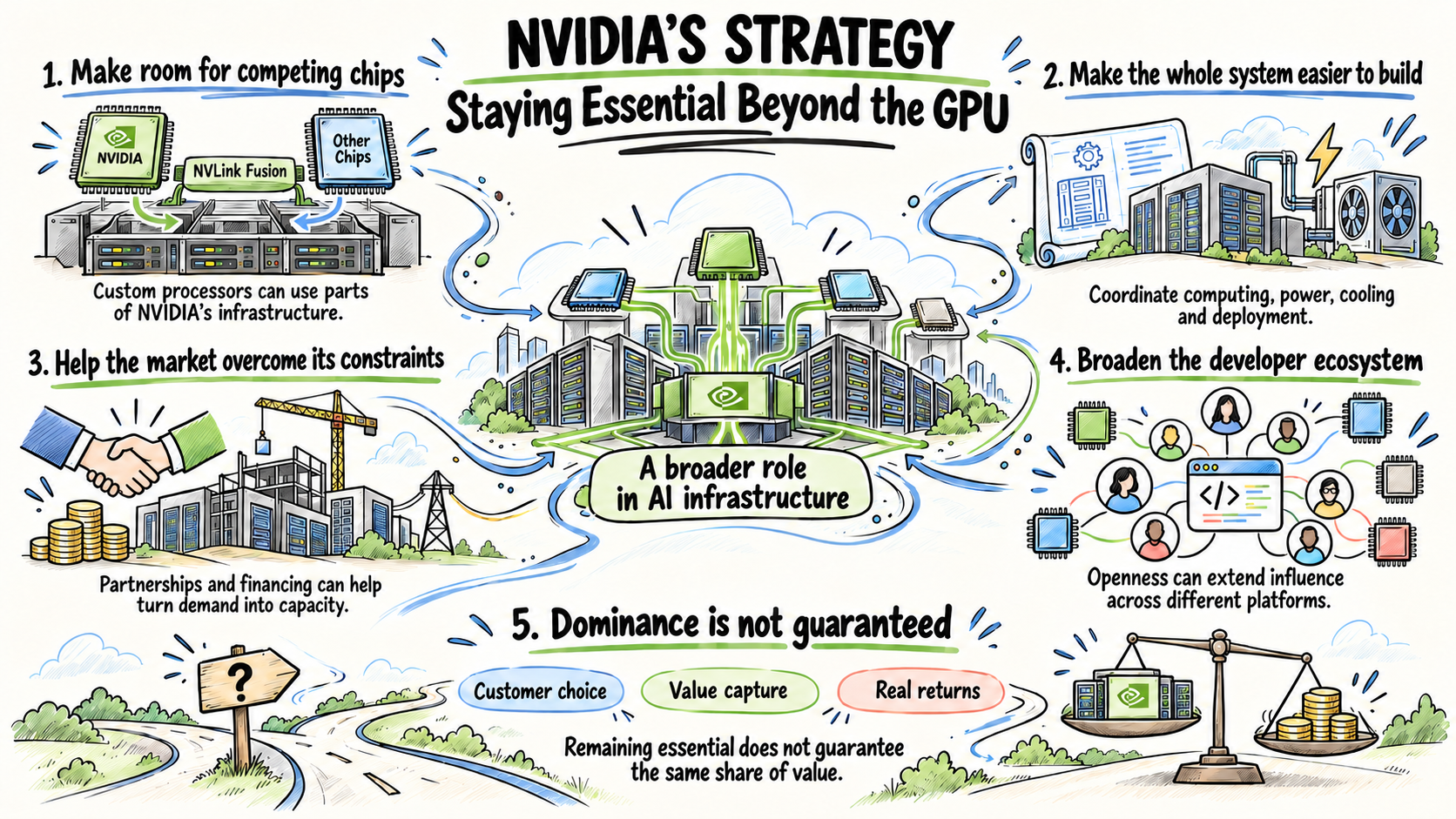
Its NVLink Fusion initiative allows customers to integrate custom processors into parts of NVIDIA’s computing architecture. AWS plans to use that technology with Trainium 4, an accelerator from its own competing chip family. A customer choosing an alternative to an NVIDIA GPU could therefore still choose NVIDIA technology to connect the processors and help deploy the system. That is a more interesting development than another faster chip.
In my October 2024 article, I argued that NVIDIA’s advantage came from the combination of GPUs, CUDA, networking and its developer ecosystem. It was already a platform company and a market builder. The platform strategy that helped NVIDIA achieve dominance does not guarantee that it can sustain it. As customers develop competing processors NVIDIA may remain essential to AI infrastructure without retaining the same degree of dominance or capturing the same share of economic value. Its next moves therefore should be understood as an attempt to shape that outcome whose success remains to be demonstrated.
My reading is that NVIDIA is broadening the places where it can create and capture value. It wants to sell the accelerator but it is also creating ways to remain involved when somebody else supplies it.
Let competitors into parts of the system
Introduced in May 2025, NVLink Fusion gives custom silicon designers access to NVIDIA’s interconnect technology and rack-scale ecosystem. It reduces the amount of surrounding infrastructure they need to develop themselves.
Consider the attraction for a cloud provider. Designing a processor is one challenge. Connecting many processors at high speed, integrating them into racks and supporting deployment at scale are additional challenges. A proven interconnect and established supply chain can make custom silicon easier to bring to market.
For NVIDIA, the attraction is different. Custom accelerators need not represent a complete departure from its ecosystem. They can become another market for parts of it.
There are important limits to this argument. NVLink compatibility does not make a custom accelerator a CUDA processor. AWS has its own Neuron software stack for Trainium. Nor does NVLink Fusion forces customers to buy NVIDIA networking throughout. NVIDIA explicitly supports integration with third-party network adapters, data-processing units and scale-out switches.
This is selective interoperability, not control of everything surrounding the chip. It gives NVIDIA another opportunity to earn a place in a customer’s design, rather than guaranteeing that place.
The distinction is central to the strategy. NVIDIA is not abandoning its GPU advantage. It is trying to make its participation in AI infrastructure less dependent on winning every processor decision.
Make the whole system easier to build
That opportunity becomes more valuable as the difficulty of deploying AI infrastructure increases.
A processor has limited value while it waits for power, cooling, network capacity or integration work. Buyers need a functioning system, not simply a collection of high-performing components. The cost of delay can matter alongside the cost of the equipment.
NVIDIA’s DSX platform addresses this broader problem. Its May 2026 announcement brings together reference designs, simulation, infrastructure software and facilities integration for AI factories. Rather than stopping at the rack, the design encompasses how computing equipment interacts with the environment required to operate it.
For customers and partners, the proposition is less integration work and a faster path to production. For NVIDIA, the potential benefit is influence earlier in the design process. An architecture selected before construction can shape subsequent equipment, software and operating decisions.
But reference designs are not ownership. DSX is modular, and what NVIDIA does is describing a mix of open software and partner technologies. Builders can adopt selected components. The strategic opportunity lies in making that coordinated approach attractive enough to choose, not in making every component compulsory.
Help the market overcome its constraints
Some obstacles cannot be solved through engineering alone.
In January 2026, NVIDIA announced a $2 billion investment in CoreWeave alongside a broader collaboration intended to accelerate AI-factory construction. This includes access to land, power and data-centre shells. In August, it announced agreements in principle with six financial institutions aiming to mobilise more than $500 billion of third-party capital for AI infrastructure over time. Those financing partnerships remained subject to final agreements when announced. The headline figure is an ambition, not capital already deployed.
These initiatives extend the same logic beyond the technical platform. If customers cannot finance or accommodate thr infrastructure, demand for processors cannot become deployed capacity. Helping remove those constraints can expand NVIDIA’s obtainable market.
This is not a neat sequence in which chips mattered first, networking second and power third. All remain important. What changes with scale is the commercial significance of coordinating them.
NVIDIA doesn’t need to own every complementary business. It can combine proprietary technology, open designs, investments and partnerships. The relevant question is whether those arrangements make infrastructure easier to build around its products and more attractive for customers to operate.
Openness can also be part of the advantage
The September 2026 agreement to acquire Hugging Face extends this approach towards developers and model distribution. Importantly, NVIDIA has said that Hugging Face will continue supporting different clouds, frameworks and accelerators, without requiring NVIDIA compute.
That commitment complicates any simple story about NVIDIA closing the ecosystem around itself. A broad, trusted developer platform can be valuable precisely because it serves people who do not exclusively use NVIDIA.
My interpretation is that NVIDIA could benefit from wider AI adoption and closer involvement in developer workflows without forcing every workload onto its hardware. The tension is whether it can improve the platform while preserving the trust that makes such openness useful. In this case ownership would create influence. It would not automatically create developer dependence.
Where the strategy could fail
There is a coherent pattern here but coherence is not proof of success. In my opinion there are three important tests.
The first is whether customers continue choosing NVIDIA’s architecture when alternatives become credible. AWS’s plans for NVLink Fusion are evidence of cooperation not surrender. AWS also participates in the leadership of UALink, an alternative accelerator-interconnect initiative. A large customer can collaborate with NVIDIA while helping develop other options.
The second is whether broader participation produces enough economic value. Selling interconnect technology around a rival accelerator is not necessarily as profitable as selling the accelerator itself. NVIDIA could expand its presence across a system while losing value in its most lucrative layer. More architectural influence and stronger financial returns are not the same thing.
The third is to see if the infrastructure earns its keep. Financing can remove a capital constraint. However, it cannot establish that the applications running on the resulting capacity will generate sufficient returns. Lower token costs help but tokens are an intermediate output not the customer’s final measure of value.
If NVIDIA invests in companies that also purchase its products, it becomes exposed through both the investment and the commercial relationship. That does not make the demand artificial. It does mean the strategy should be judged by sustained utilisation, customer economics and repeat demand not only by investment announcements or planned gigawatts.
In conjunction these tests prevent an attractive strategic narrative from becoming an assumption of inevitable dominance.
Defend the position not only the product
In 2024, I asked whether NVIDIA could maintain the relatively closed relationship between CUDA and its GPUs. NVLink Fusion does not dissolve that relationship. Instead, it adds another route through which NVIDIA can participate in the wider computing system.
This is the more useful way to understand its next phase: an extension of the platform strategy, not a departure from it.
For other business leaders the lesson is not to expand into everything surrounding a successful product. That would be a very expensive way to lose focus. It is to identify the dependencies that determine whether customers can obtain value from the product then decide where the company has a credible ability to improve them.
Sometimes that requires tighter integration. Sometimes it requires a partner. Sometimes it means making room for a competing component because doing so makes the surrounding offer more useful.
NVIDIA is testing whether it can defend its position by broadening the reasons customers choose it. The outcome depends on how much value those customers actually receive and how much of it NVIDIA can retain.
Replacing an NVIDIA GPU may not mean leaving NVIDIA behind. That is the strategic possibility worth watching.
Sources
- NVIDIA: AWS integrates NVLink Fusion for Trainium4 deployment, 2 December 2025. See also AWS’s description of future NVLink Fusion support.
- NVIDIA: NVLink Fusion announcement, 18 May 2025.
- NVIDIA: NVLink Fusion configurations and third-party networking compatibility, 21 August 2025, subsequently updated. AWS Neuron software overview.
- NVIDIA: DSX platform announcement, 31 May 2026.
- NVIDIA: modular DSX reference architecture, 16 March 2026.
- NVIDIA and CoreWeave collaboration, 26 January 2026. NVIDIA: proposed infrastructure financing platforms, 10 August 2026.
- NVIDIA: agreement to acquire Hugging Face and platform commitments, 3 September 2026.
- UALink Consortium leadership, including AWS.