Technology & innovation
What Platform to Build in the Age of Cheap Answers
A practical guide for platform builders, executives, and investors
This is my second article inspired by the writings of Sangeet Paul Choudary on platforms. In his essay When answers get cheap, good questions are the new scarcity, Sangeet argues that as AI drives the cost of answers toward zero, the scarce, and valuable, capability becomes asking questions that reduce uncertainty and focus attention. Drawing on the shift from photography to Impressionism and on Shannon’s information theory, he makes the case for reframing problems and building systems that sustain inquiry amid structural uncertainty.
My goal here is to translate that strategic idea into a guide for platform builders. To help you move up the value chain and avoid the commoditization trap. That guide, in one line, boils down to: stop selling answers and build the system that produces decisions reliably (e.g. context APIs, workflows orchestration, and guardrails). I also provide some pointers for executives and investors on where to allocate budget and what evidence to underwrite as you build.
The case for the coordination layer
Here’s the core idea: as LLMs drive the marginal cost of answers toward zero, value shifts to the coordination layer (problem selection, context, and orchestration). Platforms that codify which questions get asked, with what data, inside which workflows, under which controls will capture the durable economics. Why? Because coordination becomes the scarce resource, owning the interfaces (APIs), contracts (e.g. schemas, event definitions), and guardrails (e.g policies, audits, controls) that decisions run through, makes you the default route to outcomes.
That position compounds. Switching costs rise. The share of API touched revenue increases. Also, NRR strengthens and gross margin mix improves as more work flows through automated, instrumented paths. Partners invest and customers expand. Investors don’t pay for answer novelty, they pay for durability, the system that turns answers into auditable decisions and cash flow.
Why the shift happens (the economics)
As models get “good enough”, the returns to raw answer quality start to flatten. The advantage no longer comes from squeezing a few more points of benchmark accuracy. Instead, it comes from owning the context in which those answers are used and the distribution that puts them to work. Economically, that’s classic commoditization: when many suppliers can produce similar outputs, prices converge and value migrates to the complements.
The real cost, and the real moat, moves to coordination. Turning an answer into an outcome means lining up data from different systems, applying policy, triggering the right tools, and getting a fast human “yes/no” when risk requires it. That orchestration is where time and money are actually spent. Reduce that friction and you create willingness to pay. This is why platform gravity matters. If you own the interfaces, the contracts, and the governance layer, you sit in the middle of every decision your customers make. That position compounds: more integrations make you stickier, more partners build on you, and the same customers expand their spend. Public and private investors recognize that pattern and reward it with better valuation multiples, not for the story, but for the durability it implies.
Strategic implications
Builder lens — what to build
Clearly, this is easier said than done. The pivot to stop selling answers and start selling the system that produces decisions reliably is a complex and demanding. In practice, that means turning customer context into product (clean data contracts and predictable events), running work through opinionated workflows instead of ad-hoc prompts, and embedding guardrails so policy and audit are built in from the start. Then, bring partners into that system on clear economic terms so they can extend you and get paid for it.
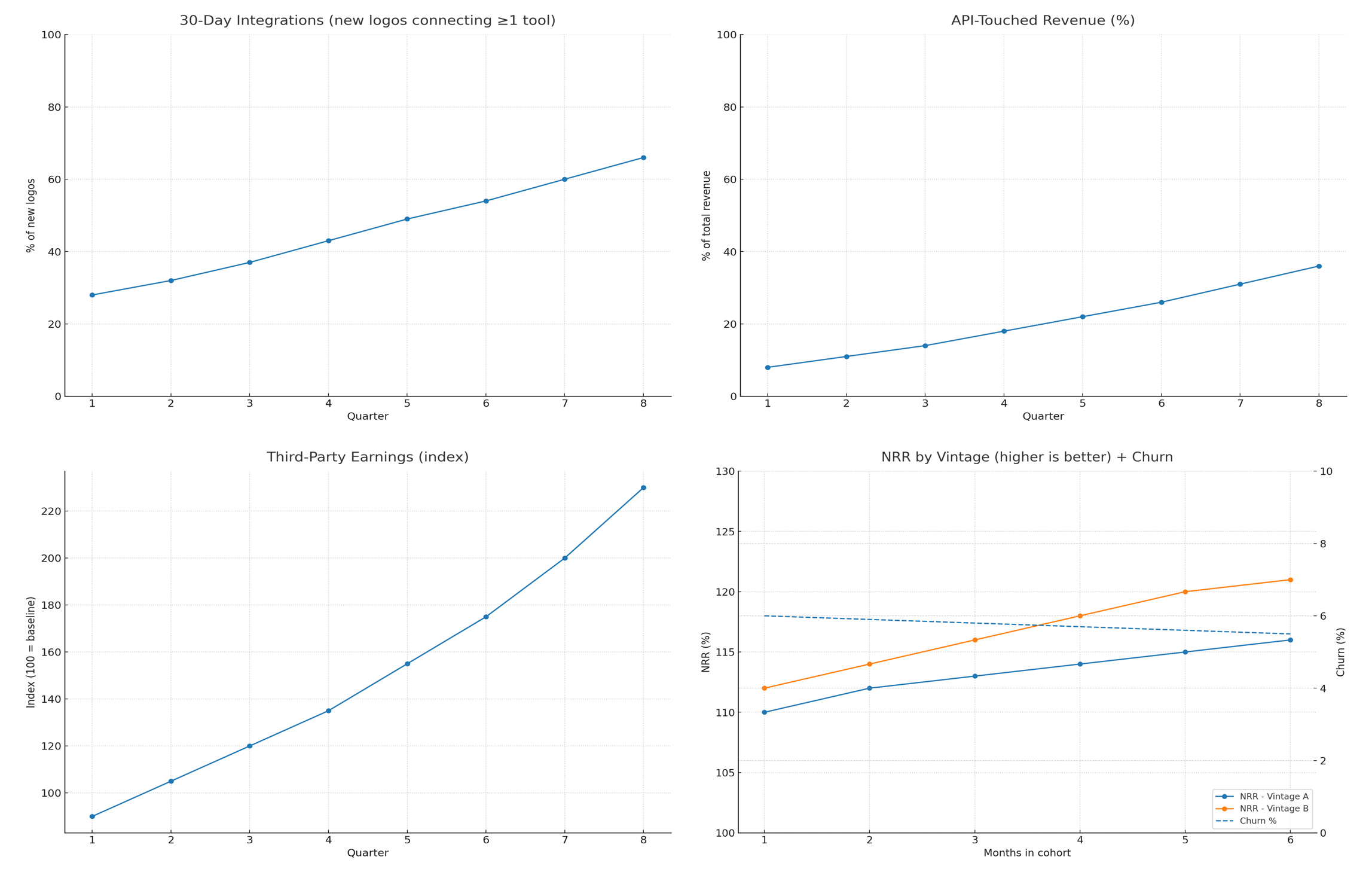
If you’re doing this well, you should see it in the operating curves without shouting about AI at all. As new customers connect something in the first month, a growing share of revenue flows through API-touched workflows. In turn, partners ship and earn on your platform, and same-customer revenue (NRR) steps up while churn stays flat. Build that system, and the answers (along with the valuation multiples) tend to take care of themselves.
Executive lens — turning strategy into budget
If answers are commoditizing, budgets should shift from one-off model experiments to coordination assets: context APIs, a couple of boring-on-purpose workflows, and the guardrails that make decisions auditable. Sequence spend so that each release bends a curve you can show the board. By that I mean 30-day integrations, API-touched revenue %, third-party earnings & release cadence, NRR by vintage, all while churn stays flat/down. That’s how you justify the next tranche.
Investor lens — what to underwrite
Premium valuation multiples don’t follow model benchmarks, they follow evidence of durable economics. Look for rising integration depth early, API-touched revenue gaining mix, partners shipping and earning on-platform, and cohorts expanding (NRR increasing) without promotional spend. However, beware “marketplace theater” launched before stable APIs, adoption will lag and the curves won’t move.
The Three Moves
Move 1 — Productize Context (make it addressable)
Productizing context sounds abstract, but it’s a practical move. The aim is to make the who/what/where of a customer’s work addressable so that every decision request arrives with its backstory. In practice: durable IDs for key objects, a thin stream of events as things change, and policy that travels with the data. Ask the same model the same question on your platform and it does better because it sees what matters.
What: Turn context into product: stable APIs, data contracts, and events that expose the who/what/where of a customer’s workflow (entities, histories, permissions).
Why it captures value: Context is the non-fungible input that makes the same model yours. It raises switching costs and improves outcomes more than swapping models.
How to ship it (in one breath): Make context addressable. Settle canonical objects/IDs, emit small consistent events and webhooks, carry policy metadata on every record, and maintain first-party adapters for your top systems.
What good looks like (acceptance criteria):
· Tieme to First Integration (TTFI) decreases 50% within two quarters
· 30-day integrations ≥ 50% of new logos
· API-touched revenue ≥ 25% and rising
· Developer NPS increases (docs/SDK satisfaction improves)
Move 2 — Orchestrate Workflows (from prompts to processes)
Prompts are great for demos but workflows are what survive Tuesday afternoons. The goal is to run the same decision the same way every time, with clear steps, guardrails, and a place for a human when risk requires it. Make it boring-on-purpose and auditable. That’s when trust (and spend) show up.
What: Replace ad-hoc prompting with multi-step, tool-using workflows: retrieve -> decision policy -> act -> human review -> log.
Why it captures value: Orchestration turns cheap answers into repeatable business outcomes. It also creates the control points (SLAs, audit) enterprises pay for.
How to ship it: Codify one high-value decision as a workflow with explicit steps and guardrails; ship 2–3 first-party connectors; add evaluation gates and a human-in-the-loop path; instrument every run (trace IDs, cost/time/quality) so Tuesday looks like the demo.
What good looks like:
· Time-to-first automated decision ↓ 50% after the first workflow hardens
· Decision acceptance rate ≥ 80% on low/medium-risk tiers (with audit)
· Rework rate ≤ 10% and trending down
· NRR lift visible in cohorts using automated workflows (e.g. 5 to 10 percentage points vs a baseline cohort)
Move 3 — Monetize Decisions (align price to realized value)
Once context and workflows are doing real work, “per seat” and “per token” stop matching the value customers feel. What they actually buy is a decision they can rely on at a predictable cost. Pricing the decision surface aligns your revenue with their outcomes and gives partners a reason to invest.
What: Move beyond “per seat” or “per token.” Price the decision surface: usage-based units (runs/actions), outcome tiers (SLA/accuracy/compliance), and ecosystem attach (partner rev-share).
Why it captures value: You participate in the value unlocked, not just the tools used. It scales with adoption and cements partner incentives.
How to ship it: Meter decision runs and tool actions, expose cost telemetry, offer assurance tiers (Standard/Assured/Verified), and pay certified partners via a transparent marketplace take rate.
What good looks like:
· API-touched revenue ≥ 30% of total and rising
· Marketplace GMV ↑ with a healthy, stable take rate (without squeezing partners)
· NRR increases as more decisions and extensions go live
· Gross-margin mix increases as automated paths replace manual services
Putting it all together
Sequence: Prove one high-value workflow => expose its context via APIs => ship 2–3 first-party integrations => open the SDK => certify partner extensions => price the decision surface.
Why this order: deliver value fast, then stabilize interfaces before inviting partners. We price last so that we map units to outcomes, not headcount or tokens.
Governance: Ship constraints first (authz, data classification/PII handling, evaluation, etc), then features second. This means, decide who can do what, which data can be used where, and how quality is checked. Then version policies, log decisions, and make rollback safe.
How to manage evidence:
- Publish the four curves quarterly: 30-day integrations ↑, API-touched revenue % ↑, third-party earnings & release cadence ↑, NRR by vintage ↑while churn is flat/down.
- How to read them: adoption velocity, depth of embed, ecosystem health, and same-customer growth. Naturally, also you want to annotate major releases/catalysts so that cause and effect are visible.
Risks & mitigations
Compliance and model drift: Treat policy as code. Classify data and enforce residency/access in the platform while attaching evaluation suites to each workflow. Additionally, prefer shadow runs and canary rollouts before full automation. Last but not least you need to version prompts/policies, keep an always-on rollback, and preserve audit trails for every decision.
Over-automation: Define risk tiers and the thresholds that trigger human-in-the-loop. Set latency budgets so approvals don’t stall the business, and design explicit fallbacks when signals are weak. Capture reason codes for every escalation and review them in regular ops/post-mortems.
Partner quality: Certify before listing. Require security/SLA checks, versioned contracts, and automated tests. You also should ship staged release channels and revocation hooks. Keep partner incentives healthy with clear revenue floors and prune low-quality or abandoned extensions.
Quick signals to watch:
- Fewer policy exceptions and more regressions caught pre-production. This shows your guardrails and data classifications are correct and enforced in the workflow, not on email/Slack after the fact.
- Stable-to-falling escalation rate. This is important because it shows that as the models, policies, and context improve, the system is needing fewer handoffs and this is happening without raising risk.
- Partner defect rate trending down shows that the quality of the ecosystem is improving and that customers trust the marketplace
Conclusion
As answers commoditize, advantage shifts to the coordination layer: context, workflows, incentives, etc. that turns answers into auditable decisions. Build that layer and you earn durable economics.
For builders: pick one high-value workflow, ship the constraints first, and instrument every run.
For executives: reallocate spend from model demos to coordination assets and require each release to bend a curve.
For investors: underwrite the evidence: 30-day integrations, API-touched revenue percentage, third-party earnings & release cadence, NRR by vintage all while churn stays flat/down.
When those lines slope up together, compounding shows up in the P&L and premium valuation multiples stop being a story, they become the default.