Technology & innovation
Zeus GPU: Bolt’s Bet on the Long Game
(Initially published on LinkedIn)
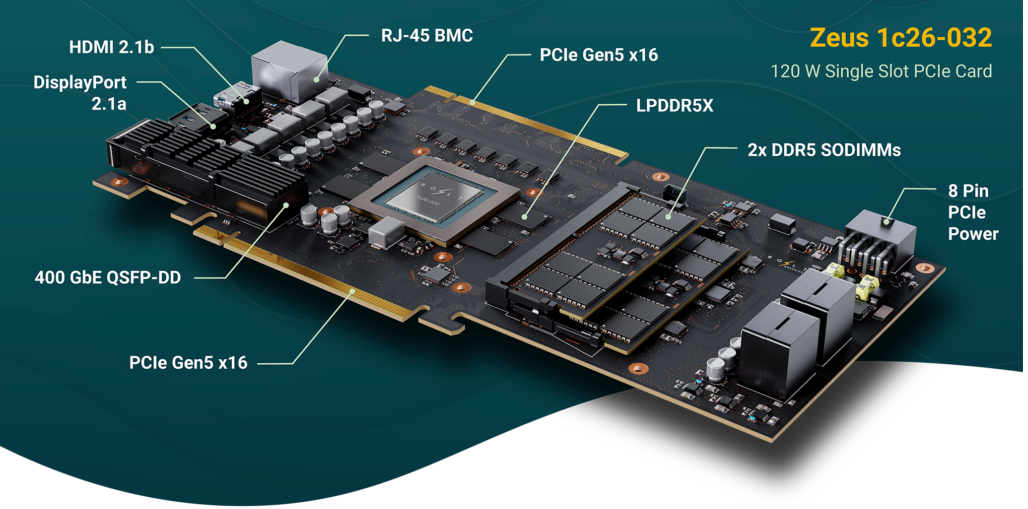
Bolt Graphics, a California startup, just announced Zeus, a GPU designed to overcome some of the limitations of legacy GPUs in rendering, HPC, and gaming. According to the announcement, Zeus delivers 10x faster rendering, 6x better FP64 HPC performance, and 300x speedup in electromagnetic simulations.
A key innovation is expandable memory, allowing users to scale up to 2.25 TB per Zeus GPU and 180 TB per rack, exceeding existing solutions. The company claims that unlike traditional GPUs, Zeus increases efficiency while reducing energy consumption.
Another feature is the integration of 400 GbE and 800 GbE Ethernet directly into the GPU. This enables direct GPU-to-GPU connectivity at scale, reducing latency and improving overall performance.
Zeus will be available in PCIe cards, servers, and the cloud. Bolt plans to create a unified GPU architecture across multiple platforms.
Why This Is Important:
- Zeus is a chiplet based architecture leveraging open-source RISC-V ISA, Scalar CPU core (RVA23) and Vector cores FP64 ALUs and RVV 1.0 with slight modifications. Therefore, avoiding the closed ecosystems of Nvidia’s CUDA and AMD’s ROCm, offering greater flexibility to developers and hardware partners. This could make GPUs more accessible and foster broader adoption in high-performance computing (HPC) and AI workloads.
- The combination of RISC-V Vector Extension (RVV 1.0) and Bolt’s proprietary extensions allows Zeus to be highly optimized for workloads such as scientific computing. This modular approach gives Bolt an advantage over traditional GPU architectures that have fixed design constraints.
- While Nvidia dominates AI and HPC with its CUDA ecosystem, Zeus seems to introduce a viable future alternative. Open-source developers, academia, and cloud providers looking for more control over their hardware stack may find Zeus an attractive option. The fact that Zeus integrates 400/800 GbE directly into the GPU also suggests that Bolt is aiming at massive-scale AI and supercomputing deployments.
- If Zeus improves efficiency while reducing power usage as announced, it would mark a major leap in sustainability. This is a critical differentiator in an industry increasingly concerned about energy consumption and sustainability.
My Take:
This is a step in the right direction. RISC-V lowers innovation barriers, enabling organizations to customize architectures without being locked into a vendor’s ecosystem.
However, the lack of software and developer support (for now) may prove to be a formidable barrier to wider adoption. While Zeus can leverage existing open source libraries, breaking Nvidia’s CUDA dominance is not easy feat. CUDA’s ecosystem took years of investment and has deep industry adoption.
That said, if Bolt can mobilise strong developer support and build a competitive software ecosystem, Zeus could become a serious player. Can Bolt execute?
https://bolt.graphics/wp-content/uploads/2025/03/Bolt-Zeus-Announcement-External.pdf