Strategy & leadership
No, you can’t budget your way to a strategy
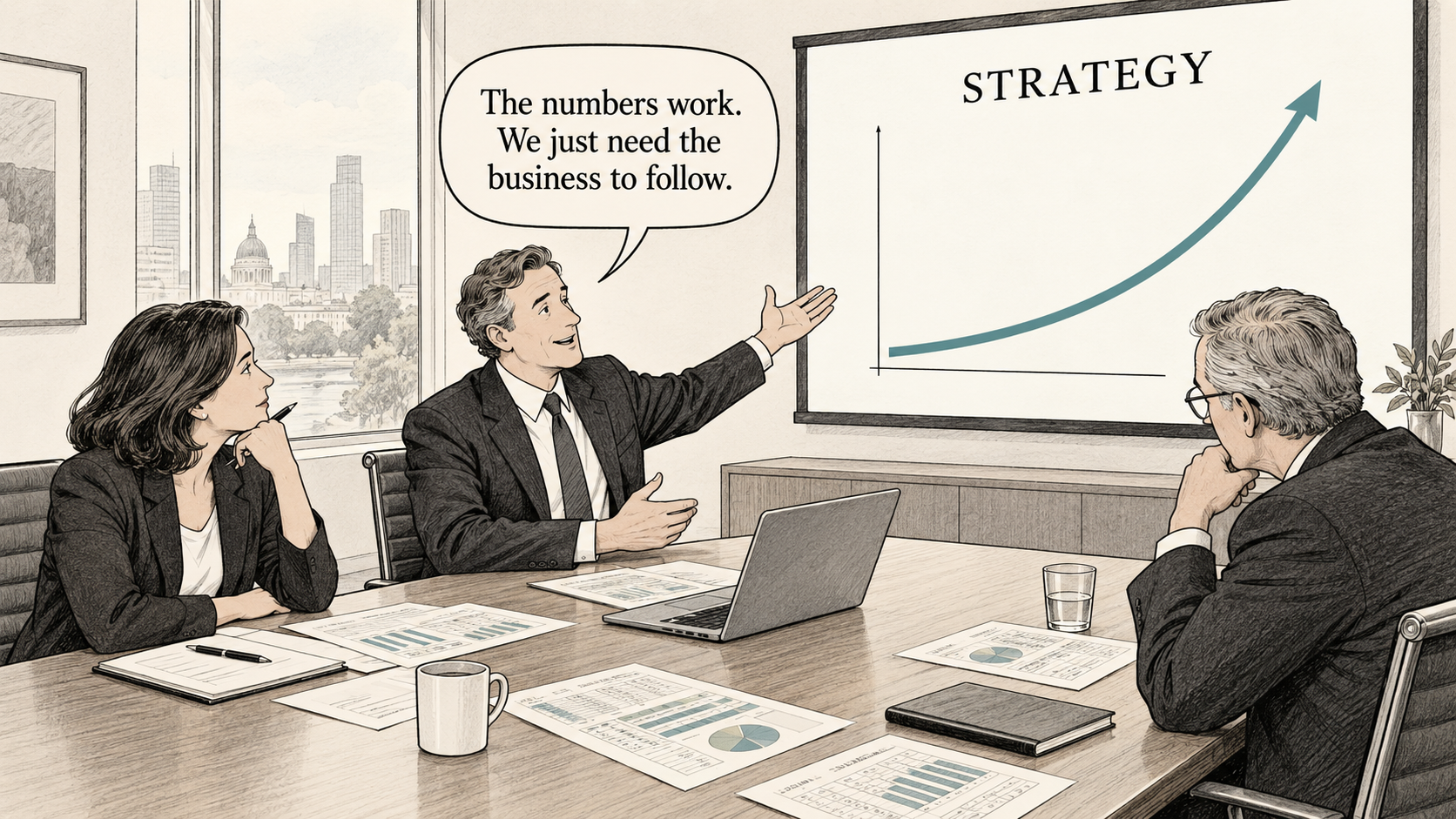
A business can be very clear about the financial results it wants and surprisingly unclear about how it intends to achieve them.
Revenue needs to grow. Margins need to improve. Costs need to come down. These ambitions are translated into budgets and forecasts, reviewed regularly and used to hold people accountable.
It can all look disciplined. But what explains why the business should be able to produce those results?
Which customer problem will it solve better? What is preventing it from doing so today? Which capabilities must it develop? Where will it concentrate its resources?
I have seen financial expectations become very clear while the reasoning behind them remained incomplete. The targets were clear. However, the choices needed to make them achievable required much more work.
This becomes particularly apparent when a business needs to transform. Some capabilities were built for an earlier market. Others have received too little investment. In some cases customer relationships can continue to generate revenue while those weaknesses remain unresolved.
The task is to understand what must change in the business for different results to become possible. Increasing targets does little to answer that question.
This is where strategy as problem solving becomes useful. But the first task is to examine how we have defined the problem. The way we describe a shortfall influences the responses we consider.
A gap in revenue may appear to call for more sales activity. Yet customers may be buying differently. The proposition may have lost relevance. The business may lack the capabilities needed to deliver what those customers now expect.
Problem framing brings these possibilities into view. It means questioning our initial explanation and considering the broader conditions shaping the business. Otherwise we may become very effective at addressing the wrong problem.
Breaking down a complex challenge into smaller parts can help us understand it. Those parts still need to be considered together. A change in customer demand may have implications for the proposition, sales approach and delivery model.
The next step is to decide where action could make the greatest difference. That requires choices about which challenge to address, what resources to commit and how the actions will support each other. As conditions change, we may need to revisit the diagnosis and adjust our response.
A financial model can help test that reasoning. It can expose an unaffordable proposal, unrealistic assumptions or an investment that offers too little return. But its arithmetic cannot establish why customers will buy or how the business will deliver what it promises.
An attractive forecast may depend on winning more customers. That expectation still needs an explanation. Why would those customers choose us? What advantage would we offer? How would competitors respond? What would we need to do well?
Without that reasoning, the forecast risks becoming a numerical expression of hope.
Targets also do more than describe ambition. Once people are required to achieve them, they influence decisions about money, time and attention.
An immediate margin requirement may push investment aside. A growth commitment may encourage expansion into markets the business barely understands. Those choices can emerge without anyone properly examining their consequences.
It isn’t uncommon to find companies whose management adjusts market assumptions to accommodate an ambitious growth target. The desired answer begins to determine the assumptions used to justify it. In those cases the organisation treats the need to achieve a result as evidence that the result is achievable.
I recognise a related problem in the work of transforming a business. A stronger portfolio does not automatically create stronger sales. People need to understand the customer problem, explain the proposition and build confidence in the solution. The business must also be able to deliver and support it.
These are connected capabilities. A revenue target does not tell us which one is missing.
When results disappoint it is tempting to intensify performance management, more reviews, revised incentives, etc. The truth is that those measures can help but their usefulness depends on the problem.
Unfortunately, financial reporting and performance reviews can become familiar ground in the absence of strategy work. But accouting describes financial performance and position. Perf management tracks progress against objectives. Strategy examines which objectives and actions make sense in the first place. They are not the same thing
Likewise, aligning people’s interests can improve motivation. But it does not guarantee that they know what to do or possess the capability to do it. People can want the result, understand its importance and still lack the experience or tools needed to achieve it. Treating every shortfall as insufficient effort can leave the actual constraint untouched.
This does not make accountability optional. It makes an accurate diagnosis essential. A gap in effort, a gap in capability and a weak strategic choice require different responses.
There is also a timing problem. Today’s results reflect earlier decisions, current execution and external conditions. They cannot, on their own, establish whether today’s strategic choices are sound.
Revenue may still come from relationships developed years ago. A profitable service may depend on a market position that is becoming harder to sustain. Meanwhile, work to improve products, systems and skills creates costs before all its benefits become visible.
This creates a difficult task for anyone leading change. You have to sustain the business while building the capabilities required for its next stage. The immediate financial picture will capture only part of that work.
The distinction is important when judging recent initiatives. A capability gap demonstrated repeatedly can require action now. However, a recently launched commercial initiative might need enough time to produce meaningful evidence. Both judgements can be valid at once.
When giving an initiative time we should actively scrutinise it. Are teams executing the work? Are customers responding? Are opportunities progressing? What are we learning that changes our view? Those questions help distinguish a delayed result from a failing approach. They also prevent patience from becoming an excuse for inactivity.
Another challenge is how decisions interact across the business. Suppose a company wants to serve customers with more demanding requirements. Its sales team needs a credible proposition. Its products need the right capabilities. Delivery needs capacity. Support needs the expertise and tools to operate the service reliably.
Now imagine that each function must independently improve its immediate financial contribution. Product postpones development. Support reduces capacity. Sales promises more to meet its target. Each decision might appear defensible in isolation. Together, they can weaken the proposition the company is trying to build.
That’s why the decisions must work together. A set of budgets can reconcile even when the business decisions behind them contradict each other.
None of this makes financial constraints less real. Cash determines how much room a business has to act. Some costs should be removed. Some investments should never be approved. A promising opportunity can still exceed what the business can afford.
The same strategic scrutiny should apply to both spending and cutting. What will the decision change? What will it release or weaken? How does it affect the business’s ability to serve customers and earn a return?
Calling expenditure an investment does not answer those questions. Nor does calling a reduction an efficiency.
Management owes the board a clear explanation of the challenge, the proposed response and the resources required. It should explain what evidence would support continuing and what would justify changing course. The board needs to examine those assumptions as seriously as it examines the forecast.
That requires enough understanding of the business to look beyond the financial presentation. Customers, technology, competition and organisational capability all belong in the discussion. Financial expertise is valuable when it helps interrogate those relationships.
In an uncertain environment, precise numbers can be reassuring. They provide something concrete to discuss and a clear basis for comparison. However, a more detailed forecast does not resolve uncertainty about whether the business can produce it.
I think the most useful question for management and boards is a simple one:
“What must change in the business to make these numbers credible?”
That question brings the conversation back to customers, capabilities, choices and action. It may also reveal that the targets themselves need to change.