Strategy & leadership
Your Strategy Has No Competitors
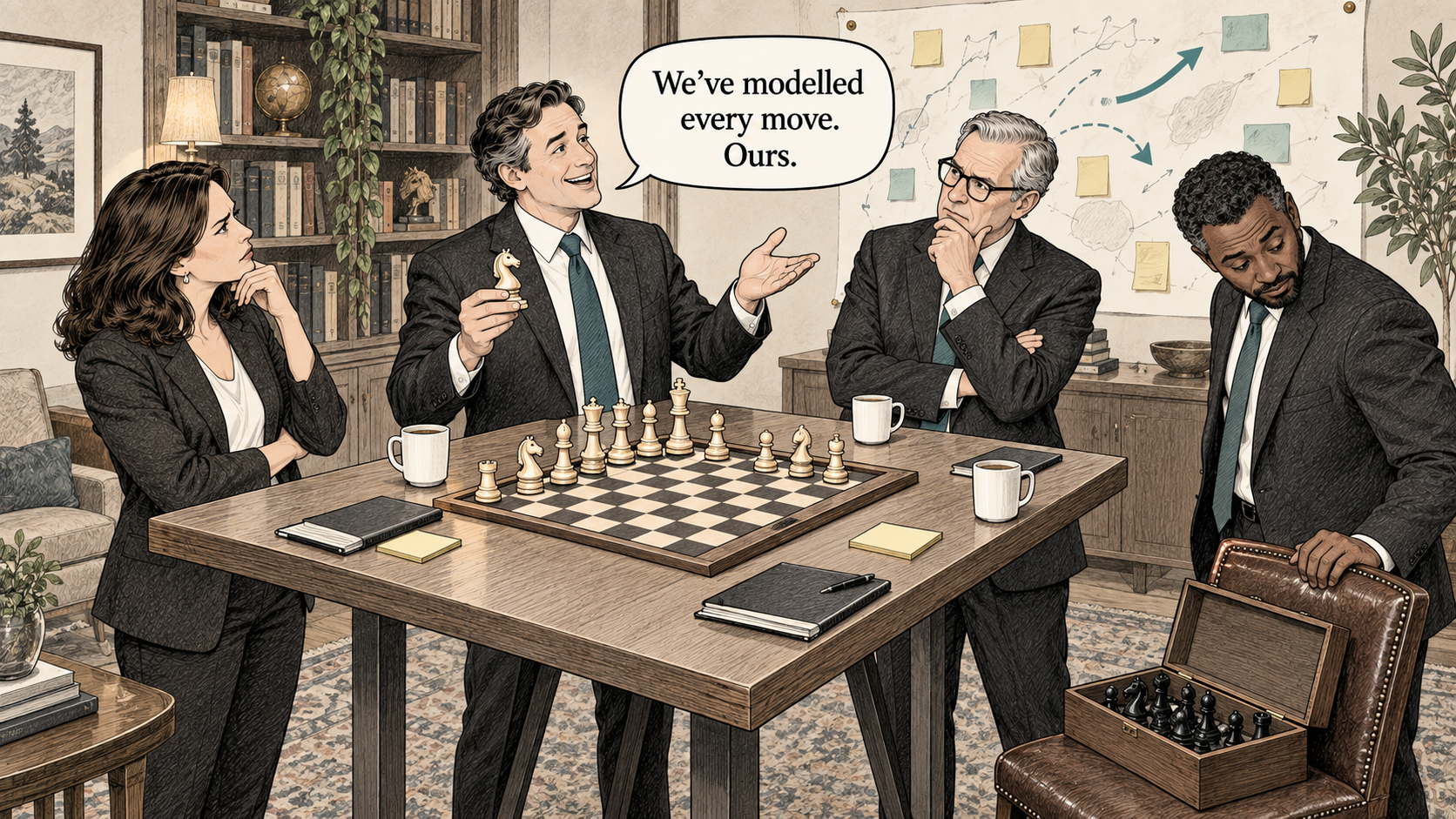
Surprisingly, most strategic plans describe the organization in motion and everyone else standing still. Many strategies are built around an oddly peaceful future. The company launches a new product. Customers adopt it. Revenue grows. Costs fall. Market share increases. Competitors remain exactly where they were.
It is not that competitors are completely ignored. They appear in market analyses, SWOT tables and positioning charts. Their strengths and weaknesses are carefully documented. But once the strategy begins, those same competitors stop making decisions.
The organization becomes the only active participant. The market becomes scenery. This is where competitor analysis is often weakest. It tells us what competitors are. It rarely asks what they will do.
Success creates a response
However, every successful strategy changes the position of other people.
If you gain market share, somebody loses it. If you introduce a lower cost model, somebody faces pressure on margins. If you establish a new platform, existing suppliers and partners may lose influence. If you remove friction for customers, competitors may suddenly appear harder to deal with. The reality is that hose affected will rarely remain passive.
They may reduce prices, copy features, strengthen partnerships, lock up distribution, change contractual terms or target your most profitable customers. They may use resources and relationships that were not visible in the original analysis. This creates an interesting problem. Strategic plans usually examine the risks associated with failure. They spend less time considering the reactions created by success.
Yet the more successful a strategic move becomes, the greater the incentive for others to respond. The relevant question is therefore not only: what will happen if our strategy works?
It is also: if our strategy works, who loses, and what are they likely to do about it? A strategy that cannot answer that question may be little more than a forecast of unopposed action.
Why competitors become passive in the process?
Organizations naturally understand their own intentions in far greater detail than those of their competitors. They know the thinking behind the product. They understand the investment plan. They can see the roadmap, the customer research and the capabilities being assembled.
Competitors are viewed from a distance. Their current products, prices and market shares are visible. Their future choices are not. This encourages what Daniel Kahneman and Dan Lovallo described as the “inside view”. Decision-makers build a detailed story around their own plans and assumptions. They treat the situation as unique and give insufficient weight to what happened in comparable situations. The organization’s own actions become vivid. Everything else becomes an assumption.
A related problem appears in Colin Camerer and Dan Lovallo’s research on “overconfidence” and “competitive entry”. Their experiments showed how people can overestimate their prospects when success depends on their relative skill. Participants recognized their own ability but gave too little weight to the fact that other confident and capable people were also choosing to compete.
The same pattern can appear in strategy. We know why our product is different. We know why our people are capable. We know why our plan should work. What we know less well is why our competitors also believe they can win.
Competitor neglect does not mean forgetting that competitors exist. It means failing to give them the same intelligence, ambition and freedom of action that we give ourselves in the process of strategy.
Look beyond the internal story
The inside view can be challenged by examining comparable situations. Instead of asking only how the current plan should unfold, the organization can ask what happened when other companies attempted something similar.
What happened when a new entrant competed on price in a mature market? How quickly did incumbents respond to a superior product? Which advantages remained valuable after competitors copied the visible features? Which business models looked attractive until several companies pursued them at the same time?
This is the outside view.
The aim is not to find one flattering analogy. Almost any strategy can be justified by selecting the right success story. The aim is to construct a reference class of genuinely comparable cases and examine the range of outcomes.
Research on robust analogizing suggests that using a broader set of relevant comparisons can improve strategic forecasting. It reduces the temptation to treat every initiative as unprecedented.
Comparable situations will never provide a perfect answer. Industries differ. Capabilities differ. Timing is also important. But imperfect comparisons may still be more useful than the assumption that the organization is unique.
Give the other side a strategy
A simple test can make competitive response part of the strategy process. Before approving the strategy, write a short response from the perspective of the competitor most threatened by it.
Ask:
- If our strategy succeeds, who loses?
- What incentives will they have to respond?
- What is their fastest and least expensive response?
- Which capabilities or relationships could they use against us?
- What would remain advantageous after their strongest plausible move?
This does not require predicting the future with precision. Competitors may respond differently from what we expected. Some may respond irrationally. Others may fail to act at all. The purpose is not to forecast one exact move. It is to discover whether the strategy depends on everyone else behaving conveniently.
The most important question is what remains after the response.
A product feature that can be copied within weeks is unlikely to provide a durable advantage. A lower price that competitors can match may simply reduce margins across the market. A new route to market may become less attractive once others compete for the same partners. The original move may still be worthwhile. However, its value should be assessed after likely responses, not before them.
Competitor-aware, not competitor-led
None of this means that strategy should be dictated by competitors. Organizations that watch rivals too closely often become imitative. They reproduce the same products, pursue the same customers and adopt the same language. Competitor analysis then creates convergence rather than advantage, which is not what we want.
Strategy should still begin with an important challenge, a customer need or an opportunity that the organization is unusually equipped to pursue. Competitor response serves a different purpose. It tests whether the resulting choices are credible.
Customer insight can help identify where to play. Organizational capabilities can determine how to win. Competitive response tests whether the advantage is likely to survive. Competitors do not need to see your strategy presentation. They only need to experience its consequences. If the strategy begins to work, they will make choices of their own.
A strategy is not credible simply because its internal logic is coherent or because the management team agrees with it. It becomes credible when that logic survives contact with other actors who have both the means and the incentive to make it fail.
If the strategy still works after your competitors are allowed to think, choose and respond, then you may have a strategy. Until then, you have a plan for being left alone.